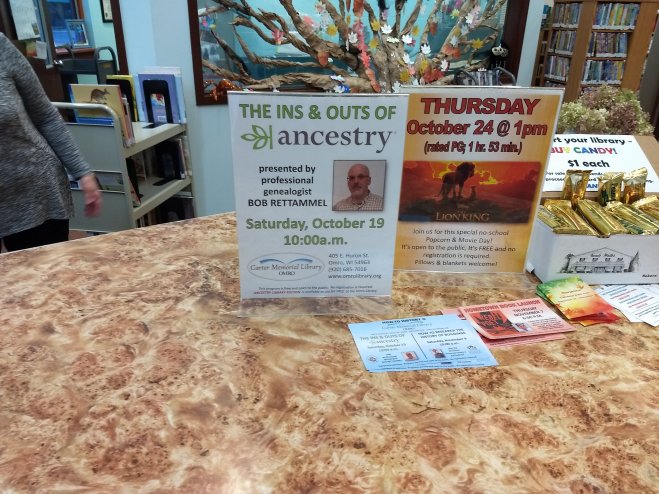
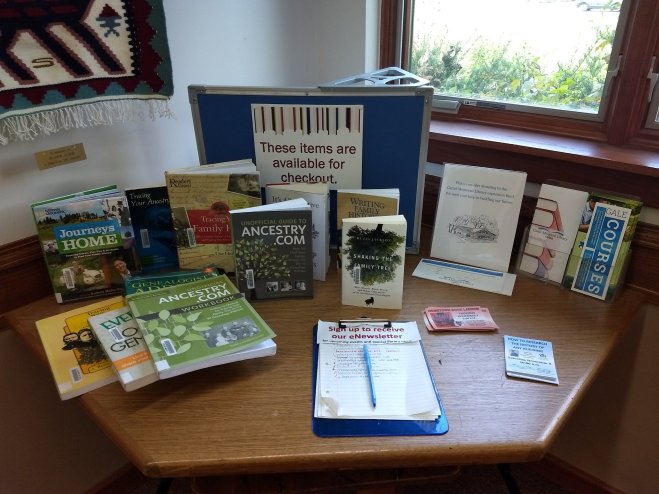
I would like to thank the 18 people at the Omro Carter Memorial Library who participated in my lecture/presentation on Ancestry.com and Ancestry Library Edition source collections. The talk also provided guidance/ awareness on genealogical principles of: evidence gathering, proof standards, source documentation and how to handle those darn shaky leaves in Ancestry trees.
Memories and stories are important part of family history.
Early memories, under 6 years old, tend to be sketchy at best. However there
are some thoughts of childhood that do resonant through artifacts or belongings
that bring up feelings and jar memories of ancestors. One of those recent
belongings that was part of my childhood memory is a chair that my paternal
grandmother had in her house. This chair was situated on the front porch of the
home and was used by my Grandmother in the last years of her life. My
grandmother died when I was 6, so my memories of her are limited but with
pictures and this particular chair I remember being 4 and 5 years old visiting
her and being on the porch sitting with her in this chair (pictured below). I
still remember her hands resting around my waist holding me as she rocked the
chair slowly while my parents and uncle were in deep conversation about the
recent news items in the town or world of the late 1960s. My father was the
youngest of 12 children and by the time I was born my grandmother was a widow
and just turned 77 yrs. old. So my recollections of her is a person who loved
children, moved slowly and had a kind smile when she felt healthy.
Vintage Kroehler Rocking Chair My Grandma owned
After my grandmother died, the chair stayed on the front
porch in about the same place for the next 40 plus years. I sat in the chair
many more times throughout the years my uncle lived in the house and my family
visited there. Eventually the house it was in was sold to a new family in about
2014. Before this family moved in I removed my Grandma’s chair from the porch
and brought back to my own house and put it in storage. The chair was not in
the best condition even then and was by my estimate over 70 yrs. old. The
condition of the chair deteriorated and eventually became a home for mice while
in storage. Originally I kept this chair intending to get it reupholstered to
use again. Well after holding on to it too long and deciding that the value of
reuse was less important than the memory of my Grandma and my time with her, I
decided to simply take a picture and let the chair go to the dump. The memories
of being with her in the chair are more important. It was her chair not mine.
However before letting the chair go, I did some research to
learn the possible age and also who might have made this chair my grandmother
enjoyed relaxing in.
As I started to take pictures and looking closer at the
chair, I saw a tag with words, in caps DO NOT REMOVE THIS TAG under Penalty of
Law. Also the tag says the chair was made of “all new material” (at the time of
course); consisting of “Body: Cotton Linter Felt, Rubberized Sisal Pad and Wood
Fibre Pad”. “This article is made in compliance with an Act of District of
Columbia approved July 3, 1926; Kansas, approved March 1923: Minnesota,
approved April 23, 1929: New Jersey,
revised statues 26 :10-6 to 18.”
I did some research and found some interesting comments
about what this Act of District of Columbia was in the 1926.
An Act To regulate the manufacture,
renovation, and sale of mattresses in the District of Columbia.
July 3, 1926
A PDF file of
this chapter can be opened and on pages 838-840 you see that the major concern
of Public Law 489 of the 69th Congress, otherwise known as the mattress law,
was the spread of contagious venereal disease: “. . . no person in the
District of Columbia who is a renovator of mattresses shall use in whole or in
part, in the renovation of any mattress, material which has formed part of any
mattress theretofore used in and about any sanitarium or hospital, or used by
any individual having an infectious or contagious disease.” According to
the act, secondhand material could not be used in mattress like furniture
unless it had been sterilized and disinfected.
I learned a
little social and medical history about the U.S. from this chair of nearly 100 years
old. However I was also interested in the manufacturer of the chair, Kroehler
MFG. Co. So I looked up the maker of this chair and discovered a link to the
Encyclopedia of Chicago (http://www.encyclopedia.chicagohistory.org/pages/2745.html). It states, “In 1902, Peter E. Kroehler bought
the Naperville Lounge Co., a maker of wooden lounge chairs and upholstered furniture.
Kroehler built a new factory in Naperville in 1913 after the original facility
was destroyed by a tornado. Soon thereafter, he renamed the company Kroehler
Manufacturing Co.” Also I did a search of Peter Kroehler and found more at the
Naperville Museum. More on the Mr. Kroehler can be found at https://www.napersettlement.org/295/Kroehler-Manufacturing-Collection
In your genealogy research do not forget that you may have
artifacts that not only provide memories and develop stories, but you also can
learn something about the social history of the past, that also informs us who
live today.
One of the interesting aspects of being a Genealogist is hearing clients’ stories and learning about their ancestors in time and place.
I recently was at my favorite coffee shop doing some admin work for my Genealogy business and had the privilege of sitting next to person who is writer-storyteller with a focus on nature. As we happen to say hi and share space, I learned about their interest in family history and storytelling. I took the opportunity to explain how creating a family story is such a reward and benefit for those with interest in history. As we talked, I also asked if the person would be interested in networking and possibly giving a talk to my local genealogical association. We ended by exchange of business cards with intent to followup with each other soon.
I share this as a reminder that genealogy is more than charts and trees, it should be an avenue to create memories or stories. The end result being a booklet you share with future generations. Never too late to start a biographical sketch of one your special ancestors. #findyourplaceinhistory
What is a surname? A surname is the last name of person that is usually obtained through birth, adoption or marriage. In cases of marriage, historically the bride took the last name of the groom. Genealogy research often involves doing record searches with the surname of the person we are most interested.
We are also told that the surname we are given actually goes back in time for several thousand(s) years in history and can be traced back along the paternal line of our father’s father and his father, etc.
Is this true? In some families I would say that it is possible to trace the surname within one family. However there are cases when this understanding about surnames is not completely correct and can lead to discovery errors in a family pedigree. Are you related to the same Smith two generations ago, for example? The answer may only be partially correct. In cases where the name is not so common or of English origin you may even have a harder time. Misspellings of a name on a passenger list record may not really be the actual surname in the country of origin. It might be the creation of the Ship Captain or official at the port of entry in the United States. The pronunciation of names may have evolved over centuries too. Patronymic naming practices, in which a child’s surname was formed from the given name of his father, were in use throughout much of Scandinavia well into the 19th century—resulting in each generation of a family bearing a different last name. Lastly, the effect of literacy has an impact on what form a surname may have taken. Many of ancestors within the last 200 years or less may not have known how to read and write in their language of origin, so the surname we have today may not be exact when we conduct searches in place of origin. There are other reasons for possible last name changes, desire to fit in the culture, break from the past. For African-Americans of course they did not have that option, they were given or took names of their plantation owners.
The history of two names – first and last name – in the span of human time is relatively new. Generally the development of a surnames began in Europe in the middle ages, as the population started to grow, and life expectancy also increased. People also began to come more mobile and moved into towns where people with same first names but different family connections.
Recently I had a client where various surnames have been found – within a couple generations. Families from Northern and Eastern Europe many times have non-Latin or Slavic Language origins, that have different length, accent and tones when said or spelled. The client’s story on maternal side is one that has seen 3 changes to surname within two generation, one is name change upon father’s citizenship in US. Other reasons are early deaths of husbands and re-marriage. Thereafter some of the children changed their name back to birth father’s surname in adulthood.
Last name searches are not as simple and should not be assumed when doing Genealogy research. Be open to other possibilities to expand your searches of past ancestors.
NGS AND FGS ANNOUNCE INTENT TO MERGE
Dear Members:
In a historic move, the boards of the National Genealogical Society (NGS) and the Federation of Genealogical Societies (FGS) announced today their intent to merge. The two organizations, both non-profit leaders in the dynamic genealogy industry, will form one consolidated group that will continue to operate as the National Genealogical Society. Both boards approved a Memorandum of Understanding (MOU) earlier this week, and jointly announced the news at the Opening Session of the FGS Family History Conference in Washington, D.C., this morning.
Leaders of both organizations believe this merger will serve the genealogy community by improving support of both individual members and societies in the pursuit of genealogical excellence.
The organizational structure of NGS will be modified to increase functions that support genealogical societies and family organizations. Digitization projects of genealogical importance such as the War of 1812 pensions will continue. The two organizations will continue to operate independently while all details of the merger are completed, no later than October 1, 2020.
Faye Stallings, President of FGS, said: “We are excited about this opportunity to combine with a premier organization that has been in operation since 1903. This will allow for improved and expanded services to help support societies.” Ben Spratling, President of NGS, commented, “We look forward to continuing the strong legacy of FGS as a ‘gathering point’ for family historians and societies all across the nation.”
In late April 2019 a client contacted me about learning more about their Paternal Great-Grandparents, who lived in Madison, Wisc from the 1850s to early 1900s.
Research results successfully met two of the main objectives set by the client.
Some the genealogical source records located, reviewed and analyzed were the following:
Burial and Death Records.
Marriage Records.
Dane County Deeds Index 1835- 1915, at the Wisconsin Historical Society (WHS) Archives section
Land and Deeds Records at the Dane County Register of Deeds Office in downtown Madison.
Pre-1907 Wisconsin Vital Records held at the Wisconsin Historical Society (WHS) Library.
Newspaper Research Lookups – with the aid of WHS databases held in their large collection catalog.
Today all was finalized and sent to client, including a 20 page Research Report, and electronic copies of documents found to support genealogy findings.
Genealogy Proof Standards were followed to support the results.
Overall with patience, research strategies and use of proof standards learned so far, the project was fun and worth the time.
In 1899 Kentucky, Berea College’s student body was visibly more racially diverse than counterparts around the nation, thanks to the help of Cassius Clay, who’s equality work helped pave the way in that state. (Library of Congress)
On Saturday, August 10 at 11am, I will speak at the Dane County Area Genealogical Society, about my recent visit to Sacramento, California for the 2nd International German Genealogy Conference sponsored and organized by the International German Genealogy Partnership (IGGP). I will talk about the various sessions he attended over the 3-day conference that took place in June 2019, more about IGGP, the next conference in 2021 to take place in Cincinnati, Ohio and other fun items about Germanic Genealogy research application strategies for your own work. This ultimate Germanic Genealogy Conference brought together various societies and internationally known German researchers together.
“Wisconsin” (originally “Meskonsing”) is the English spelling of a French version of a Miami Indian name for a river that runs 430 miles through the center of our state, currently known as the Wisconsin River. Recent scholarship has concluded that in Miami it meant, “this stream meanders through something red.” In 2003, historical linguist Michael McCafferty convincingly argued that this was a reference to the red sandstone bluffs of the Wisconsin Dells.



 Rettammel Genealogy Service